"Modernist Kaunas: Architecture of Optimism, 1919–1939" has been on the UNESCO World Heritage List since 18 September 2023, and its best-known buildings can be seen on foot in half a day. The route below covers 11 interwar buildings in the New Town and on Green Hill. It is about 3 km long and starts and ends at the western end of Laisvės alėja.
Why Kaunas has a UNESCO-listed modernist centre
After Lithuania declared independence in 1918, Kaunas served as the provisional capital of the state. In two decades the city's area grew sevenfold, its population rose sharply, and a dense concentration of new public buildings, banks, offices and homes went up. Kaunas lost the capital status in 1939, and the districts built in those years have changed relatively little since.
The UNESCO World Heritage Committee inscribed the site at its 45th session in Riyadh under criterion (iv), as an outstanding example of a city transformed by rapid urbanisation and modernisation. It became Lithuania's fifth World Heritage site, after Vilnius Historic Centre, Kernavė, the Curonian Spit and the Struve Geodetic Arc. The property has two parts:
- Naujamiestis (New Town): a street grid planned in 1847 on the eastern edge of the Old Town, which became the administrative centre. It has the largest concentration of landmark modernist buildings.
- Žaliakalnis (Green Hill): a natural plateau rising to an average of 35–40 metres north and east of the New Town, developed as a garden-city suburb under a 1923 master plan.
According to UNESCO, about 1,500 of the city's 6,000 surviving interwar buildings are inside the listed area.
The route at a glance
| # | Building | Address | Built | Architect(s) |
|---|---|---|---|---|
| 1 | Central Post Office | Laisvės al. 102 | 1931 | Feliksas Vizbaras |
| 2 | State Savings Bank (now City Municipality) | Laisvės al. 96 | 1940 | A. Funkas, A. Lukošaitis, B. Elsbergas |
| 3 | Ministry of Justice and Seimas (now State Philharmonic) | L. Sapiegos g. 5 | 1929 | E. Frykas |
| 4 | Bank of Lithuania | Maironio g. 25 | 1925–1928 | Mykolas Songaila |
| 5 | Land Bank (now Kaunas University of Technology) | K. Donelaičio g. 73 | 1935 | Karolis Reisonas |
| 6 | Vytautas the Great War Museum and M. K. Čiurlionis National Art Museum | K. Donelaičio g. 64 | 1929–1936 | V. Dubeneckis, K. Reisonas, K. Kriščiukaitis |
| 7 | Christ's Resurrection Basilica | Žemaičių g. 31B | 1933–1940 (consecrated 2004) | Karolis Reisonas |
| 8 | Pienocentras | Laisvės al. 55 | 1931–1934 | Vytautas Landsbergis-Žemkalnis |
| 9 | Pažanga | Laisvės al. 53 | 1934 | Feliksas Vizbaras |
| 10 | Romuva cinema | Laisvės al. 54 | 1940 | Nikolajus Mačiulskis |
| 11 | Officers' Club (Ramovė) | A. Mickevičiaus g. 19 | 1935–1937 | Stasys Kudokas, Jonas Kova-Kovalskis and others |
Length and time: about 3 km (our estimate, measured on the map), or under an hour of walking. Allow two and a half to three hours with stops and the basilica roof, more if you visit a museum. The only climb is up to Žaliakalnis.
Stop by stop
1. Central Post Office — Laisvės al. 102
The walk starts at the western end of Laisvės alėja, the 1.6 km pedestrian boulevard that has been car-free since 1982. The Central Post Office by Feliksas Vizbaras was completed in 1931. Its flat roof and large windows were not to everyone's taste at the time, and the floor tiles in the entrance and main hall follow the patterns of a traditional hand-woven linen towel. The telephone exchange next door, at E. Ožeškienės g. 10, is also by Vizbaras (1935): the city built the post and telephone services side by side on purpose.
2. State Savings Bank — Laisvės al. 96
A few steps east, on the corner of L. Sapiegos gatvė, stands the State Savings Bank of 1940, today the Kaunas City Municipality. It is described as one of the last architectural symbols of Lithuanian interwar modernism. Inside it once had a pneumatic post system for internal mail, which has not survived.
3. Ministry of Justice and Seimas — L. Sapiegos g. 5
Across L. Sapiegos gatvė is the 1929 building by architect E. Frykas that housed the Ministry of Justice and the Seimas, Lithuania's parliament. It is now the Kaunas State Philharmonic, so you can see the lobby, with folk motifs carved into the column capitals, on a concert night.
4. Bank of Lithuania — Maironio g. 25
Walk north to the corner of Maironio and K. Donelaičio streets. Mykolas Songaila's bank palace was completed in 1928 and mixes neoclassical, national-style and Art Deco elements. The upper floors held an apartment for the prime minister, and the basement held the vaults. Since 1991 the building has again been used by the Bank of Lithuania.
5. Land Bank — K. Donelaičio g. 73
A short walk east along K. Donelaičio gatvė, Karolis Reisonas's Land Bank of 1935 now belongs to Kaunas University of Technology. The architect's aim was a building that would not compete with the museum next door but provide a quiet background to it.
6. Vytautas the Great War Museum — K. Donelaičio g. 64
The museum building on Vienybės (Unity) Square was built in 1929–1936 and has two museums under one roof: the Vytautas the Great War Museum and the M. K. Čiurlionis National Art Museum. The two façades are treated differently, a formal one for the war museum and a plainer one for the art museum. The square in front holds the Tomb of the Unknown Soldier with an eternal flame. The carillon in the tower was made in Belgium in 1935 and now has 49 bells.
7. Christ's Resurrection Basilica — Žemaičių g. 31B
The 1931 funicular behind the War Museum used to carry passengers up Žaliakalnis, but it has been out of service since 7 May 2025, so walk up the hill. Karolis Reisonas's church was built in 1933–1940. During the Soviet period it was turned into the Banga radio factory; it was returned to believers in 1988 and consecrated on 26 December 2004. The flat-roofed building is 69 metres long, and its main tower rises 70 metres. The 45 × 13 m roof terrace is open to visitors by lift or stairs and gives a wide view over the city.
8. Pienocentras — Laisvės al. 55
Come back down to Laisvės alėja at the corner of S. Daukanto gatvė. The Pienocentras dairy company headquarters by Vytautas Landsbergis-Žemkalnis (1931–1934) has a curved corner, black labradorite on the ground floor and an illuminated glass canopy over the ground floor. It won a bronze medal at the 1937 Paris International Exposition. The building has been used mainly by Kaunas University of Technology since 1946.
9. Pažanga — Laisvės al. 53
Next to it, at the same crossing, Feliksas Vizbaras's Pažanga building of 1934 housed institutions, publishers and editorial offices linked to the Nationalist Union. It had a meeting hall in the basement lit through glass-block ceilings and a restaurant with a roof terrace on the top floor.
10. Romuva cinema — Laisvės al. 54
Across the boulevard, Nikolajus Mačiulskis's Romuva was completed in 1940 with 687 seats, the largest and most modern cinema in Kaunas at the time. Its tower above the glazed entrance became a symbol of the building. It closed in 2007, was reconstructed in 2016–2021 and is the oldest cinema in Lithuania still in operation.
11. Officers' Club (Ramovė) — A. Mickevičiaus g. 19
The last stop is a block east, just off Laisvės alėja. An international competition for the Officers' Club was announced in 1931 and won by Estonian architects; Lithuanian architects then prepared the final project, and the club opened on 23 April 1937. Three soldier figures by sculptor Bronius Pundzius stand on the façade. The Lithuanian Armed Forces still use the building, and concerts are held in its halls. From here, walk back west along Laisvės alėja to the start, a little under 1 km.
Practical tips
- Go in daylight. In mid-December the sun sets at about 16:00, so in winter start by late morning. Façade details read best in daylight.
- Most interiors are closed to visitors. The museums, the basilica, the Philharmonic and Romuva are the easiest to enter. Check their current hours before you go.
- Basilica roof: €5 by lift or €3 by stairs, with reduced prices for students and pensioners. For winter (October–February) the basilica's website lists 12:00–18:00 on weekdays and 11:00–18:00 at weekends; the page was last updated in 2024, so call ahead.
- Comfortable shoes. The route is flat except for the climb to Žaliakalnis.
- More of the UNESCO site: the listed area continues east on Žaliakalnis to Ąžuolynas (Oak Grove) Park, designed in 1923, and its sports complex. Leave them for a second day or go by taxi.
- Combine with the Old Town. Town Hall Square is about 1 km (15 minutes on foot) from the start of the route along Vilniaus gatvė. See our guides to Kaunas Old Town in 48 hours and things to do around Town Hall Square.
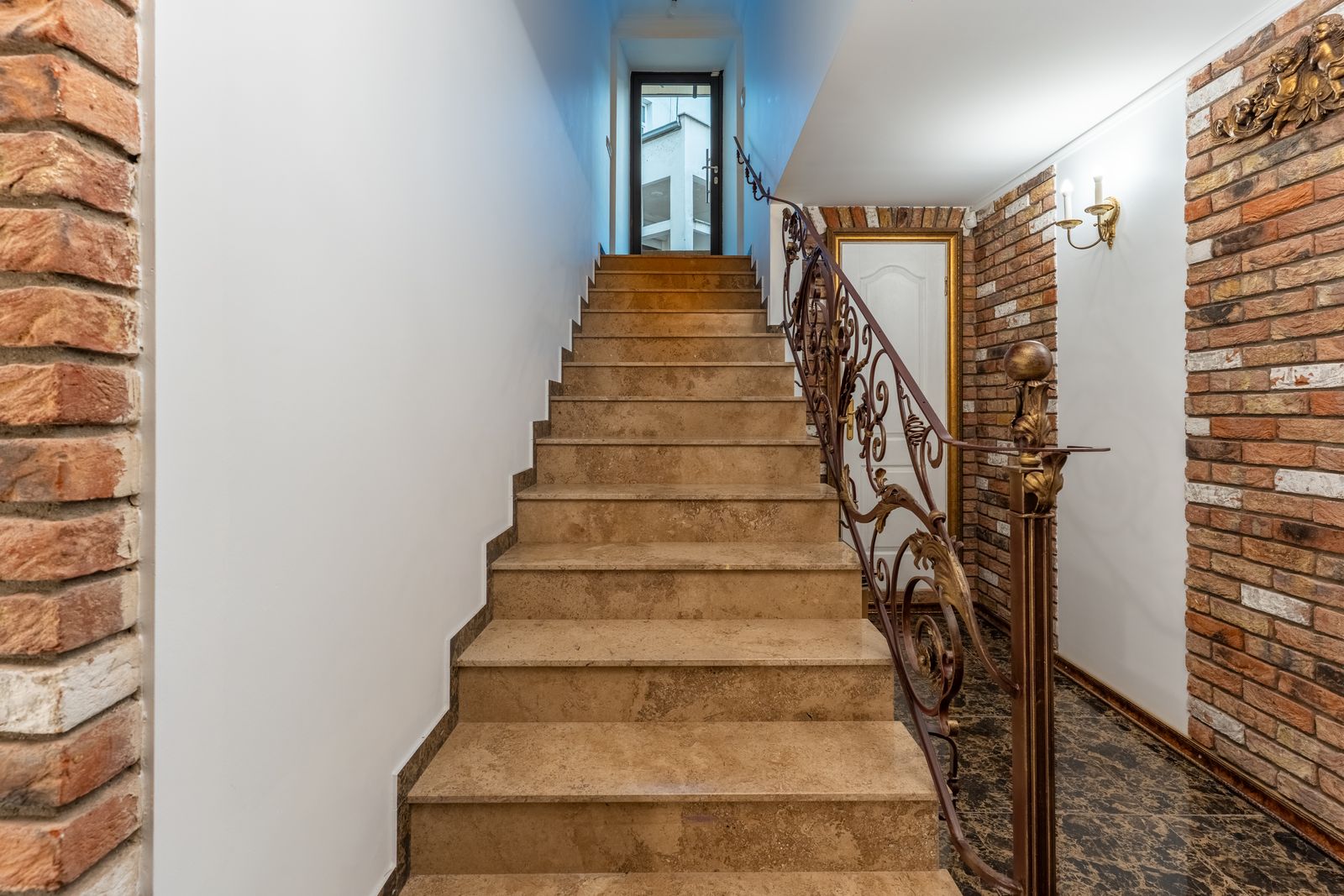
The vaulted building at the start of the route is older than the interwar boom: it dates from 1908. Its story is in Where Kaunas meets: the 1908 vaults. If you prefer to stay in the Old Town, the Picturesque Old Town Apartment and the Old Town Pearl Suite are both within 350 m of Town Hall Square.
Building data from UNESCO, the Lithuanian Department of Cultural Heritage and the Kaunas 2022 "Modernism for the Future" programme, checked in October 2026. Opening hours and prices change; check before your visit.
Frequently asked questions
What is Modernist Kaunas on the UNESCO list?
"Modernist Kaunas: Architecture of Optimism, 1919–1939" was inscribed on the World Heritage List on 18 September 2023, at the committee session in Riyadh. It covers two districts, Naujamiestis (New Town) and Žaliakalnis (Green Hill), built up while Kaunas was the provisional capital of Lithuania. It is the country's fifth World Heritage site.
How long does the modernism walk take?
The route in this guide is about 3 km, which is under an hour of walking at an easy pace. With short stops at each building and a visit to the basilica roof terrace, allow two and a half to three hours. Add one to two hours if you also go into a museum.
Where does the walk start?
It starts at the western end of Laisvės alėja, where the boulevard meets Vilniaus gatvė, Savanorių prospektas and Šv. Gertrūdos gatvė. The Central Post Office, the first stop, stands at this end of the boulevard. The walk returns along Laisvės alėja to the same point, so it works as a loop.
Can I go inside the buildings?
Only some of them. The two museums in the Vytautas the Great War Museum building, the basilica, the Romuva cinema and the Kaunas State Philharmonic are open to the public at set times or for events. The Officers' Club hosts concerts. Most other stops are offices, a bank or university buildings, so you see them from the street.
Is the Žaliakalnis funicular running?
No. The 1931 funicular behind the Vytautas the Great War Museum has been out of service since 7 May 2025. In April 2026 the operating company said it did not plan to run it and was looking for a new owner. Walk up the hill to the basilica instead; it is a short climb.
Can I visit the roof of Christ's Resurrection Basilica?
Yes, the roof terrace is open to visitors by lift (€5) or by stairs (€3), with reduced prices for students and pensioners. The basilica's website lists winter hours, October to February, of 12:00–18:00 on weekdays and 11:00–18:00 at weekends. That page was last updated in 2024, so check before going.